From the Valley to the Videoboard: How Oregon Grass Quietly Runs American Sports
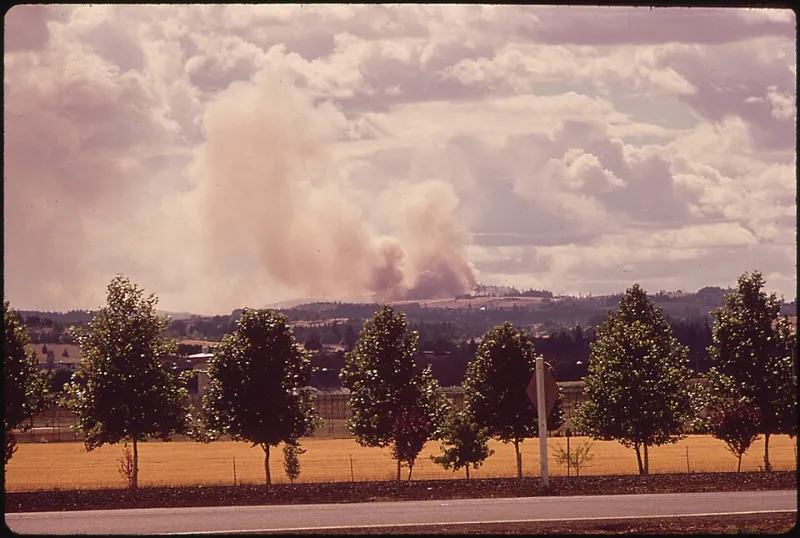
Photo: Gene Daniels, Public domain, via Wikimedia Commons
There's a moment in every football game, every soccer match, every slow-pitch softball tournament in America that nobody notices: the plant. The cut. The cleat grabbing dirt and holding. Millions of those moments happen every weekend, and a startling number of them happen on grass that started life in Oregon.
If you've driven Interstate 5 between Salem and Eugene in June, you've seen it — the haze drifting over the fields as harvest kicks up dust and chaff. That haze isn't fog. It's the smell of an industry that supplies roughly half of the world's cool-season grass seed, and the overwhelming majority of the seed used on American athletic fields.
The Crop You Never Think About
Linn County bills itself as the Grass Seed Capital of the World, and unlike most civic slogans, this one is basically just math. The Willamette Valley's mild, wet winters and dry summers are exactly what ryegrass, fescue, and bluegrass want. Farmers here have been perfecting the craft for generations, long before anyone thought to market turf as a product.
"People see a green field and think it's just there," one third-generation seed grower outside Tangent told us. "They don't realize there's a variety name, a breeding program, maybe fifteen years of trials behind what's under Tom Brady's cleats. Well, somebody's cleats."
That breeding work happens largely at Oregon State University, whose turf research program has spent decades developing varieties that recover from traffic, resist disease, and shrug off a stadium's worth of abuse. Perennial ryegrass — the workhorse of athletic fields — owes much of its modern durability to valley-bred genetics.
Following the Seed
The supply chain is deceptively simple. Farmers grow and harvest the seed. Cleaners and wholesalers condition it, test it for purity and germination, and bag it. From there it goes to sod farms, suppliers, and groundskeepers across the country. A bag of turf-type tall fescue sold at a home improvement store in Atlanta likely made the same journey as the sod laid down at a Major League Soccer stadium in Texas.
Groundskeepers, it turns out, are loyal to the source. "When you call a supplier and ask for Oregon-grown ryegrass, you know what you're getting," a head groundskeeper for a midwestern minor-league ballpark explained. "There's a trust there. It germinates when the bag says it will."
That reliability matters most in the fall, when fields take a beating and repair windows are measured in days. Overseeding a worn-out soccer pitch in October with fast-germinating ryegrass can be the difference between a playable field and a canceled season — and that ryegrass almost certainly came from the valley.
The Invisible Athlete
Here's the thing about grass: the better it is, the less anyone talks about it. A perfect playing surface disappears. Nobody writes columns about the turf holding up through a doubleheader, the way they would about a blown call or a buzzer-beater.
That invisibility is a point of pride out here. The farmers we spoke with weren't angling for credit. But there is something quietly remarkable about it — a single agricultural region, roughly a hundred miles long, underpinning the literal ground game of American sports. Youth leagues, high school stadiums, college cathedrals, pro venues: the roots trace back to the same valley floor.
Next time you watch a receiver make a sharp break on a Sunday afternoon, consider the footwork underneath the footwork. Somewhere in Linn County, a farmer is already thinking about next year's crop — the one you'll never notice, doing exactly what it was bred to do.